If you’ve spent enough evenings exploring a good bottle, you start noticing how each drink carries a story. And watching Indian Alcohol Brands evolve over the years has felt like witnessing an Indie talent becoming a headline on the world stage.
Royal Challenge, Officer’s Choice Blue, Kingfisher, and the ever-faithful Old Monk. These bottles carried every kind of “cheers”. They are also becoming popular among the world’s best alcoholic beverages.
You must have heard the news that Indri’s Diwali Collector’s Edition 2025 won “Best World Whisky” at the Las Vegas Global Spirit Awards 2025. Beating top contenders around the world.
With a score near-perfect. And there are many other items in the list that are recognised as “Best From India To The World”.
In this blog, we will find out the foundation of the Indian alcohol industry, and how Indian Brands grew and claimed their place globally.
Foundations of India’s Alcohol Industry
Long before India had award-winning single malts, beer and rum, our country was already rich with its own drinks. Every region had a signature spirit.
For example, Mahua is popular in the central Indian states and in the Northern states. Primarily prepared by tribal communities from the flowers of the mahua tree (Madhuca longifolia).
And many other drinks, such as Feni, toddy, are consumed in India way before colonisation.
The colonial era introduced modern brewing methods, large-scale distillation, and a culture centred around whisky and beer.
India watched, learned, and eventually began refining its own take on these global favourites.
By the time the first mass-market whiskies and beers rolled out, the stage was ready. Those early decades weren’t glamorous, but they were essential. They built the groundwork for everything India would eventually pour into the world.
India Steps Into the Global Whisky Map (2000s onwards)
The 2000s felt like the moment India got noticed globally.
After decades of budget blends and familiar labels, a new wave of premium single malts stepped forward, and suddenly the world started paying attention.
Behind all this rise was one powerful natural advantage: India’s warm-weather maturation. Barrels breathed faster, flavours deepened quicker, and spirits gained a richness you don’t usually find without decades of ageing elsewhere.
What some saw as a challenge, Indian distillers turned into a signature strength.
By the end of the 2000s, India wasn’t trying to join the global whisky map anymore. It had already marked its place and won the hearts globally.
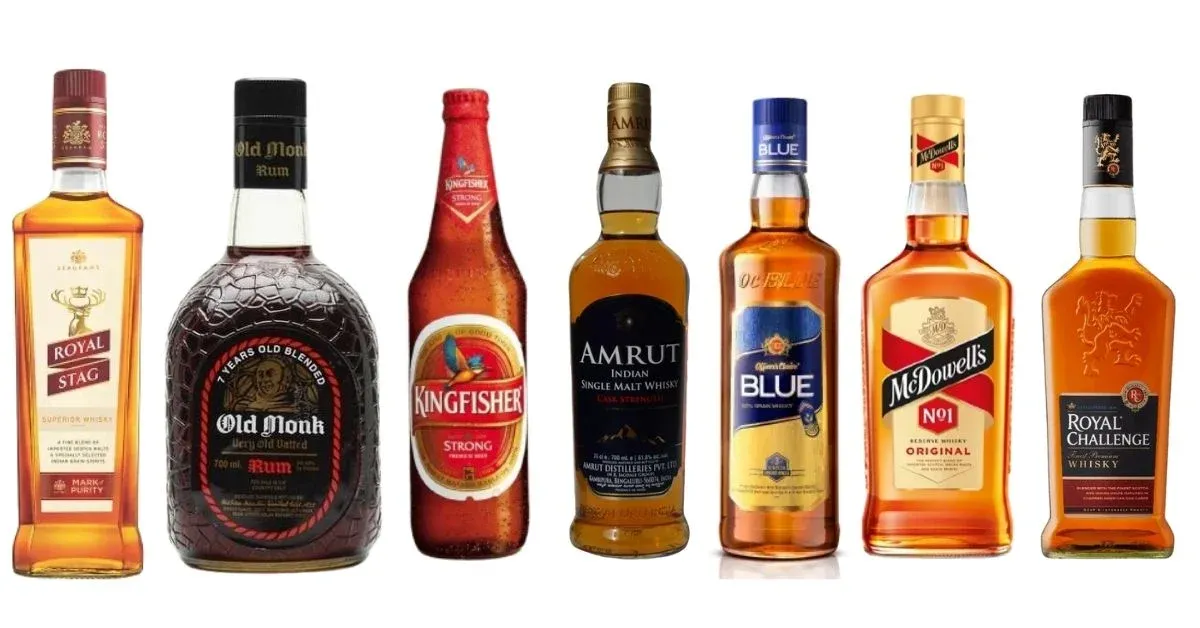
Here are the 7 Indian alcohol brands that evolved over the decades and have become world-famous today.
7 Indian Alcohol Brands Popular On Global Stage
India’s biggest names didn’t appear out of thin air. Each one started quietly, found its rhythm, and eventually stepped onto the world stage:
Amrut began in 1948 in a Bangalore-based distillery, later surprising the world with single malts that broke tasting-room expectations and permanently shifted global perception.
McDowell’s No. 1, launched in 1968, grew on the back of consistency and affordability, eventually becoming one of the world’s highest-selling spirits. Now enjoyed in 20 countries.
Royal Stag arrived in 1995, introducing grain whisky at scale. Its clean, contemporary profile helped it go international faster than many expected.
Officer’s Choice Blue built its rise on accessibility. Starting in the 1980s, the signature drink Blue was introduced in 2011. It tapped into everyday drinkers and soon climbed global sales charts.
Royal Challenge Whisky, born in the 1980s, blended Indian grain with imported malts, creating a smoothness that made it a long-standing favourite at home and abroad.
Kingfisher Beer, “the king of good times,” started in 1978, growing from a local lager into an international symbol of “Indian chill,” found in pubs from London to Dubai.
Old Monk Rum, launched in 1954 by Mohan Meakin Limited, didn’t rely on ads or flash. Word of mouth, deep flavour, and unmatched nostalgia turned it into a global cult classic. Read why Old Monk is the most loved drink in winter.
Together, these brands show how India went from regional brewing traditions to global recognition, one bottle, one loyal drinker at a time.
Future Of The Liquor Industry In India
Classic brands are reinventing themselves, craft distilleries are experimenting with drinks, and premium whiskies and rums are suddenly drawing international eyes.
It’s no longer about just making more; it’s about making bold, memorable, and world-class flavours that tell a story in every sip.
And then there’s the zero-alcohol category. Mocktails, alcohol-free beers, and non-alcoholic whiskies are finding their own place in the market of health-conscious drinkers.
India’s liquor world is no longer one-dimensional; it’s inclusive, innovative, and ready for anyone who wants to raise a glass.
Conclusion
All Indian alcohol brands begin in local distilleries and regional brews to win the hearts on the global stage, Indian alcohol has travelled a remarkable journey.
Every Indian origin brand combined heritage, innovation, and bold experimentation to redefine what India could offer the world.
Meanwhile, classics like Old Monk, Royal Challenge, and Kingfisher reminded us that nostalgia and consistency matter just as much as awards and acclaim.
Indian alcohol brands have proven one thing: the world takes notice when tradition meets vision, always crafting something extraordinary.
That’s it for today. Thank you for reading this article. To read more on the top alcoholic beverages, visit our blog page.