
When people talk about premium whisky, single malt whisky is often one of the first categories that comes to mind. Known for its distinctive character, rich flavours and traditional production methods, single malt has become increasingly popular among whisky drinkers in India.
But what exactly is single malt whisky? Is it the same as Scotch? How is it different from blended whisky? And how much does a bottle of single malt whisky cost in India?
India has also developed a growing reputation for producing premium single malts. Brands such as Amrut, Paul John and Rampur have helped put Indian single malt whisky on the global map, while newer Indian expressions are giving whisky enthusiasts even more options.
In this article, we’ll look at the history of single malt whisky, how it is made, popular brands and single malt whisky prices in India.
Single malt whisky is whisky produced at one distillery using malted barley as the grain. It is generally produced using traditional copper pot stills, although the exact legal definition can vary depending on the country.
The word “single” refers to the distillery, rather than meaning that the whisky comes from a single barrel or a single batch.
For example, a single malt can contain whisky from several casks, provided the whisky was produced at the same distillery.
The Scotch Whisky Association describes single malt Scotch whisky as whisky produced at a single distillery from malted barley and distilled in copper pot stills.
Several factors influence the character of a single malt whisky:
This combination means two single malt whiskies can taste completely different even though they follow broadly similar production principles.

One of the easiest ways to understand single malt whisky is to compare it with blended whisky.
Single malt whisky is produced at one distillery using malted barley.
Blended whisky, on the other hand, combines different whiskies. Depending on the style, a blend may contain malt whisky and grain whisky from multiple distilleries.
This doesn’t mean that single malt is automatically “better” than blended whisky. They are simply different styles designed to offer different drinking experiences.
Single malts are often chosen by people who want to explore the character of a particular distillery, while blends can offer a balanced and consistent flavour profile.
The history of malt whisky is closely connected with Scotland, where whisky production developed over centuries.
Early whisky production was very different from the modern premium whisky industry. Distillation techniques gradually developed, while commercial distilleries and improved cask maturation helped create the whisky styles that consumers recognise today.
For much of the modern whisky industry’s history, blended Scotch was considerably more commercially important than single malt. Single malts later gained greater recognition as brands began highlighting individual distilleries and their distinctive production styles.
Today, single malt whisky is enjoyed around the world, with major whisky-producing countries including Scotland, Japan and India.
India may be better known internationally for its large whisky market, but the country has increasingly gained recognition for premium Indian single malt whisky.
One of the biggest names in this development is Amrut.
Amrut Distilleries was established in Bangalore in 1948. The company began exploring malt production in the 1980s, later launched its single malt internationally, and introduced Amrut Single Malt at Cafe India in Glasgow in 2004.
The tropical Indian climate also creates a very different maturation environment compared with Scotland. Warmer conditions can result in faster interaction between the spirit and oak, producing distinctive flavour profiles.
Other Indian producers have followed, helping establish India as a serious player in the global single malt category.
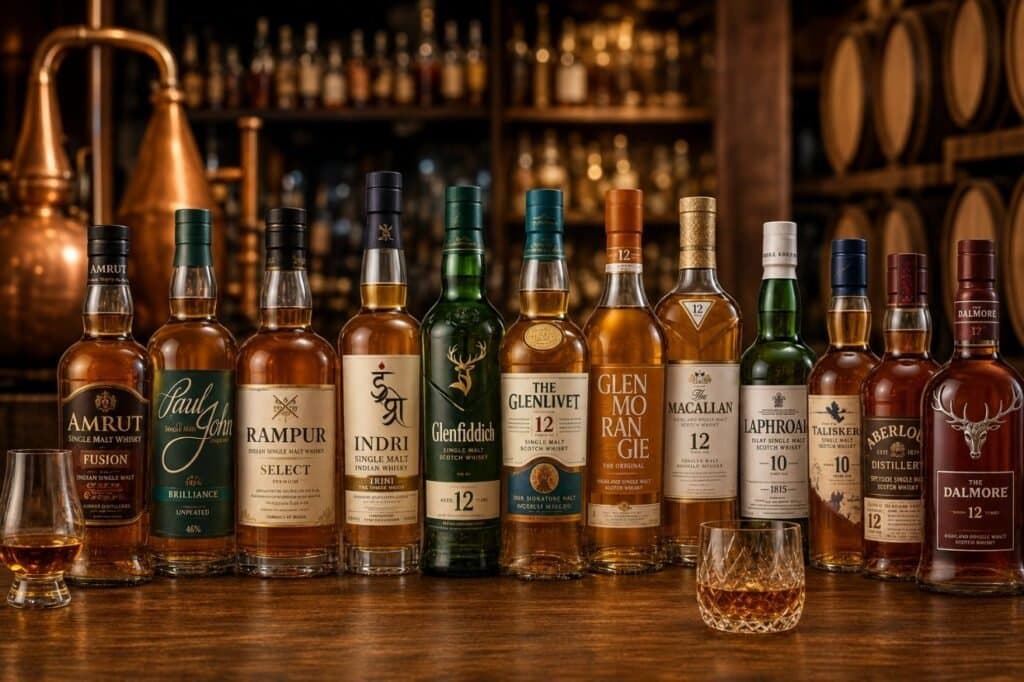
There are several Indian and international single malt brands available in India. Availability and pricing can vary considerably between states because alcohol taxation and distribution regulations differ across the country.
Amrut is one of the pioneers of Indian single malt whisky.
Based in Bangalore, Amrut has developed a broad range of single malt expressions, including classic, peated and cask-strength releases. The brand’s tropical maturation approach gives its whiskies a distinctive Indian character.
Amrut Fusion is particularly well known among whisky enthusiasts and helped bring international attention to Indian single malt.
Produced in Goa, Paul John is another major name in Indian single malt whisky.
The brand uses Indian six-row barley and matures its whisky in oak casks in Goa’s tropical climate. Its range includes Brilliance, Edited, Bold and several select-cask expressions.
Paul John Brilliance is an approachable option for people who are beginning to explore Indian single malts, while Bold offers a stronger peated character.
Rampur Indian Single Malt comes from the Radico Khaitan distillery in Uttar Pradesh.
The distillery dates back to 1943, and Rampur whisky is distilled in copper pot stills and matured in the foothills of the Himalayas. The brand’s location and climate are an important part of its identity.
Rampur offers several expressions, including Select, Double Cask and Asava.
Indri has become another notable name in India’s growing single malt category.
Its expressions are available at different price points, with Indri-Trini being one of the better-known bottles. Current retail listings show that Indian single malt prices can range widely depending on the expression, location and bottle size.
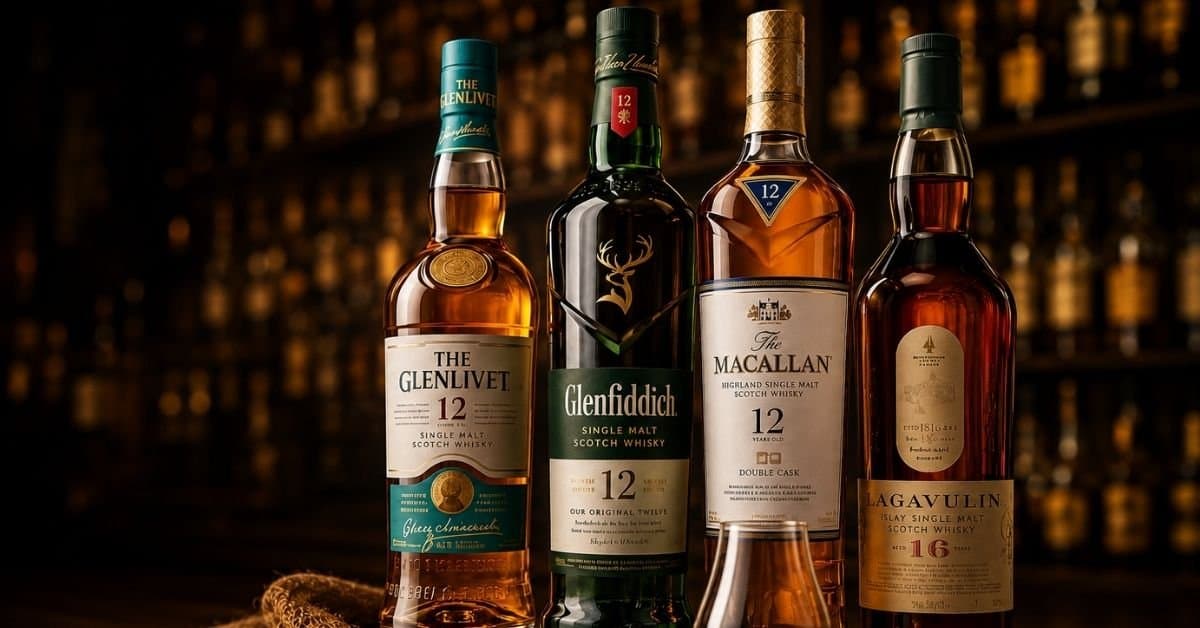
Indian consumers can also find several international single malt Scotch brands, including:
Prices can be considerably higher than Indian single malts because imported spirits are affected by customs duties and state-level taxes. Recent changes to India-UK trade arrangements are also expected to influence Scotch pricing, although the final retail price still depends heavily on state taxes and distribution.
The single malt whisky price in India can vary significantly depending on the brand, expression, bottle size, state and retailer.
As a broad indication, current retail listings show Indian single malts starting at roughly ₹2,500–₹3,000 for some expressions, while premium and limited-edition bottles can cost ₹10,000, ₹20,000 or considerably more. Imported Scotch single malts can also range from around ₹4,000–₹6,000 for some entry-level bottles to tens of thousands of rupees for premium expressions.
*Prices are indicative only. Actual prices can differ substantially between Indian states, cities, retailers and bottle sizes.
For example, current listings in Kota show Amrut Fusion around ₹4,415, Indri-Trini around ₹5,250, Paul John Brilliance around ₹5,330 and Glenfiddich 12 around ₹5,710, while premium expressions can cost far more.
Several factors contribute to the price of single malt whisky in India.
Single malt requires malted barley, fermentation, distillation and lengthy maturation. Oak casks also represent a significant cost.
Whisky must spend time in casks to develop its flavour and character. During maturation, some of the liquid is lost through evaporation, commonly referred to as the “angel’s share.”
In India’s warmer climate, maturation can be particularly active. Paul John, for example, notes an angel’s share of around 8% in Goa.
Alcohol taxation differs from one Indian state to another. Imported whisky can also face additional costs associated with import duties, distribution and retail.
This is why the same bottle may have noticeably different prices in Delhi, Mumbai, Bengaluru, Goa or other parts of India.
There is no single flavour profile for single malt whisky.
Depending on the distillery, casks, and production methods, you may experience flavours such as:
For example, Amrut expressions can display rich and complex oak, fruit and spice characteristics, while Paul John’s range includes both unpeated and strongly peated expressions.
This variety is one reason whisky enthusiasts enjoy exploring different single malt brands.
There is no single correct way to drink single malt whisky.
Many enthusiasts prefer to start with it neat, allowing the aromas and flavours to come through without dilution.
You can also add a few drops of water. A small amount of water may open up certain aromas and make the whisky feel softer on the palate.
If you prefer whisky over ice, a large ice cube can reduce the temperature more slowly than smaller cubes.
For someone trying single malt for the first time, a simple approach is:
Start neat → take a small sip → add a few drops of water if desired → compare the flavours.
The goal isn’t to follow a strict rule. It’s to find the way you enjoy the whisky most.
Absolutely. India’s single malt industry has developed significantly, and Indian producers are creating whiskies with characteristics that reflect the country’s climate, ingredients and maturation conditions.
Amrut helped establish India’s presence in the international single malt category, while Paul John, Rampur, Indri and other producers have expanded the range available to whisky drinkers.
For someone new to single malt, Indian expressions can also be an interesting starting point before exploring Scotch, Japanese or other international styles.
Single malt whisky is more than just an expensive bottle of whisky. It represents a particular production style where whisky comes from a single distillery and is made primarily from malted barley.
From Scotland’s long whisky tradition to India’s rapidly growing premium whisky scene, single malts offer an enormous variety of flavours and styles.
If you’re choosing your first bottle, consider your budget, preferred flavour profile and whether you want an Indian single malt or an imported Scotch. Brands such as Amrut, Paul John, Rampur and Indri offer excellent starting points, while Scotch single malts provide another fascinating category to explore.
Before buying, always check the current local retail price and availability in your state, as single malt whisky prices in India can change significantly by location.
For more whisky insights, brand comparisons and alcohol-related content, keep exploring OnlineAlcohol.in.